

Reviews: Alien Clay (18)
“Very Interesting story!”
(Paperback)
This was a very interesting take on alien life on alien worlds compared to earth life style. The sheer bizarre differences between the strictly controlled Mandate way of life from which Arton and other dissenters/subversives are sent on a one way trip to Kiln which is teeming with symbiosis of everything makes for a cool thinking story that is hard to put down. Especially after the enlightening march back to the camp that Arton and the others take when their flier is destroyed out on an excursion. Tchaikovsky’s books I have come to realize are quite the psychological journey as well as a science fiction novel. A bit heavy at times but they do get you thinking in ways that might not naturally occur. This was a good read and well done!
“A creeping infection of a novel”
(Hardback)
I am a huge fan of Adrian Tchikovsky’s writing. His novels always feel surprising: full of fresh insight, memorable characters, epic worlds, and dynamic plot development. Alien Clay is another success to add to the list.
Disgraced scientist Arton Daghdev is sentenced to a life of hard labour on an alien planet for crimes against The Mandate; earth’s ruling dictatorship. Old habits dies hard and there’s just too many questions about the planet’s mysterious ruins, the Commandant, and the prison population for this rebellious professor to ignore.
A modern, speculative science fiction that reads something like a scifi/thriller Catcher in the Rye meets 1984 with aliens, academic posturing, and revolutions.
I can’t lie, it’s wordy and science-ey and I had to reread a few passages to make sure I understood what was going on. However, this narrative style was so true to our MMC’s personality that I absolutely loved it. Arton Daghdev is a sarcastic, pretentious waffler: he loves to hear himself speak and he is downright hilarious. If you just sit back and let yourself enjoy the show, you’ll walk away with surprising insight into the role of science in our everyday social issues and some incredibly hilarious commentary on human nature. Daghdev is a delightfully unreliable narrator, with-holding information from the reader and doing his best to paint the picture he wants you to see. He is charmingly self-deprecating when he lies to you, and even more so when he lies to himself, that again: you can’t help but enjoy the show.
I’m still reeling from the ending and trying to decide if it was wonderfully hopeful, or the most horrific stepford demise imaginable. It was a mixed bag to say the least. On the one hand, I found parts of it to be predictable and a little disappointing. On the other hand, I felt like someone slipped me some hallucinogen and I was slowly losing my mind to a chaos I couldn’t fully understand. I hold these contradictions lightly in my hands and am left with the lasting feeling of a novel that both entertained me and challenged my view of the world.
This book looked at themes of the self vs the group, revolutions and dictatorships, power and weakness, and the surprisingly complicated and co-dependent relationship between science, politics, and social issues.
Alien Clay is a creeping infection, by the time symptoms of mistrust and fear set in, it’s too late to turn back and all that’s left is to push forward to an absolution. Philosophical, sarcastic, alien, and completely on point.
“Tchaikovksy at his very best...”
(Paperback)
Adrian Tchaikovsky’s writing not only encompasses an impressive range of subjects and sub-genres within SFF – his stories also vary in tone between the angry savagery of City of Last Chances and the mordant humour running through Spiderlight. I loved the sound of this premise, as Tchaikovsky’s aliens are always interestingly different and was hoping for something with a bit of wry humour, given my current mood.
As luck would have it – I was in for a solid treat. This tale is told in first-person viewpoint by Professor Arton Daghdev, an academic specialist in xenobiology and environmental systems. He is also an outspoken critic of the Mandate, the political orthodoxy running all humanspace. And while there were plenty of disappearances and arrests, he was under the impression that those academics speaking out against the ideas underpinning the Mandate were being given a free pass. They weren’t. They were being given sufficient leeway to thoroughly incriminate themselves. Hence he’s ended up on a penal colony thirty light-years away from Earth with no prospect of returning.
I was thoroughly on Arton’s side from the opening paragraph – his disgust at the situation he’s found himself in, his dark humour, his searing honesty about his own weaknesses and fears were both poignant and endearing. It was a nice change – often Tchaikovsky’s protagonists aren’t all that likeable. It didn’t hurt that the book started with a bang, as Arton wakes up while the ship is disintegrating around him. And from then on, the tension doesn’t let up. The prisoners’ lives are horribly cheap – after all, there will be a new consignment of victims being ejected into the atmosphere in due course.
Arton gives us a ringside seat into his life as a prisoner on the one planet, other than Earth, with proven intelligent life. Life that has simply disappeared, after leaving unmistakeable traces of their existence in the form of buildings covered with writing. And Arton is on the team to try to figure out what the signs are saying. He has his doubts regarding the whole exercise – and being Arton, doesn’t bother to keep his views to himself. Which gets him into a packet of trouble in a place where that sort of bother can easily kill you…
I loved the tale, tearing through the 400-page book in two days as I was desperate to discover what would happen next. Tchaikovsky doesn’t do predictable plots. And this one has one doozy of a twist that has me now thinking about the very clever way he’s flipped this whole sub-genre on its head. With me thoroughly rooting for Arton. This story is every bit as compelling as Children of Time and Spiderlight – two of Tchaikovsky’s best works in my opinion. I wouldn’t be surprised if he garnered yet another award for this one. Whatever awesomeness is waiting in the wings during the rest of the year – I’ll eat my keyboard if this one doesn’t make My Outstanding Reads of the Year 2024. Very, very highly recommended. While I obtained an arc of Alien Clay from the publishers via Netgalley, the opinions I have expressed are unbiased and my own.
10/10
“A terrific novel”
(Hardback)
Before Nineteen Eight-Four was published, George Orwell played with many of its themes in his other writings, especially his regular newspaper columns. In one of these he wrote something to the effect that even the strictest of totalitarian regimes would have, for a time, to respect natural laws: when designing a rocket, one had to proceed on the basis that two plus two equals four, even if the Party decided that the answer was five.
But only for a time. Complete power would dissolve this need, and in his new book Alien Clay, Adrian Tchaikovsky gives us a world - worlds - past that point, where the natural, as well as the social, sciences are expected to toe the line of The Mandate, the cabal that runs Earth now. The problems that leads to when they encounter alien life - truly alien life, not Star Trek style bipeds with funny faces - is a focus of this book. The narrator, a respected academic who's been purged for unorthodoxy, is condemned to a penal colony on an alien world, Kiln, where the effort is on to portray the missing race that constructed strange, ceramic towers now overrun by jungle, as a human analogue.
For humans, it's basically a death world, the alien flora and fauna aggressive, adaptive and dare I say it, subversive. Protective gear and decontamination are essential, yet only provided half-heartedly - after all, the workforce is expendable, and destined never to go home. Even the ships that bring them are minimal, as cheap as will serve, breaking up on arrival. Life is then brutal.
It's a tough gig, and Arton Daghdev, thirty light years from home, is hampered in his task by doubts - doubts about who betrayed him, doubts about who he may have betrayed, doubts about who he can trust now. That's how they get you, he tells himself several times. That's how we get you. In another parallel with Nineteen Eighty-Four, it's understood that, cornered by the Mandate, everyone will crack. And this is equally true of the invasive, ineluctable wildlife of Kiln, a tour de force of invention that Tchaikovsky manages to make both truly alien, almost incomprehensible, and therefore deeply threatening - but also, precisely because it so different, also utterly beyond the silly political games being played out by the invaders from Earth. It's a long time since I read SF with such a strange native flora and fauna. As I said above, it's not people in elaborate costumes, it's not life as we know it, Jim, it's - well, simply weird, challenging the human sense that we "are the first of things". I won't try and describe it both because that would rather spoil the story and because I'm not sure I can. You'll have to read the book to find out what's going on here.
What I will say is that Tchaikovsky is not only playing with exobiology here, he's also riffing off parallels between revolution - its failure modes explored at length - and that alien life, he's studying the powerful and their failures of imagination, their inability to understand that the world will not be what they wish, because they wish - in a salvo that could be aimed at climate denialism and species destruction we see here the ultimate consequence of that failure and it's not a safe or pretty story.
At the same time, Daghdev himself (the g is silent) is a fascinating study, a figure who gives away very little of his past - his story leaking out rather than being set down - and whose relationships and likely behaviour in his new setting are mysterious. The novel is as much a discovery of him as it is of Kiln - and what a novel it is, one I'd strongly recommend, deeply compelling form the first page to the last.
Alien Clay draws an eerie parallel between Arton's radical past, with its "revolutionary sub-committees" and the roiling, baffling array of alien life to be found on Kiln.
“Alien Clay Review”
(Hardback)
This fair and unbiased review was conducted based on an uncorrected proof copy of the book, which I am grateful to the publisher for providing.
Opening with a bewildering and exciting planetfall in which snatches of memories come back to main character Professor Arton Daghdev, Alien Clay is taking no prisoners (somewhat ironically). “Dropping you into the action” doesn’t get much more literal than this, with characters whose names we’ve only just read in the dramatis personae offed dispassionately, Tchaikovsky making clear early on that Daghdev and his fellow prisoner’s lives are worth little in the eyes of the Mandate.
Those who are familiar with Tchaikovsky’s work will doubtless have noted some common themes recurring here; the Mandate, for example, have more than a little in common with the perfection-obsessed Palleseen of City of Last Chances, both rigid authoritarian regimes that provoke rebellion from the principal characters. Here, however, we get a much more focussed view of the rebellion, as everything is shown from the perspective of Daghdev rather than a sprawling list of players. As rebellion-centric as Tchaikovsky’s work sometimes is, it can’t be said that he’s just going over the same ground, as he’s always finding new angles to come at these subjects from. And, of course, there are the unique worlds he creates to set these revolutions on.
And what a wonderful world Kiln is. Little more than a stay of execution for most inmates, its persistent ecosystem wants nothing more than to find its way inside them and get comfortable, with predictably unpleasant results for them. Its wildlife are chimeric hybrids, composite creatures formed of a number of unique and highly specialised individual organisms working together. It’s chop-shop biology, essentially, and it’s this more than anything else that makes Alien Clay really unique. It’s brilliantly constructed world building at almost a cellular level, resulting in something which feels genuinely alien. Curiosity at what combination of mouths, eyes and tentacles Tchaikovsky is going to come up with next is almost enough to keep readers turning the pages by itself.
On top of all this though is the mystery of just who built the ruins dotting the surface of Kiln. Daghdev is perfectly placed to solve this mystery, his background as a xeno-ecologist meaning he is more capable than anyone else on the planet of providing some insight into the identities of the vanished builders. He’ll need help on the way though, in the form of a memorable supporting cast. There’s Primatt, leader of the bioscience team, walking the tightrope between the Mandate’s orthodoxy and unfettered science - or unorthodoxy - with increasing difficulty, the straitjacket beliefs of the regime rendering meaningful discovery challenging, if not downright impossible. Then there’s Keev, leader of one squad of the misleadingly jauntily named “Excursions.” They’re charged with heading off into the wilderness of Kiln to clear newly discovered ruins, a job with a staggeringly low life expectancy, justifying his grizzled and pragmatic attitude. Essentially, it’s as colourful and likeable a cast of characters as Tchaikovsky has ever assembled.
Even if some of its later revelations aren’t quite as dramatic as some might expect, this hardly detracts from another memorable and enjoyable story from a rightly revered master of genre fiction. This is a cautionary tale of lurking authoritarianism, as winningly and witheringly satirical as ever, with worldbuilding par excellence. It’s consistently thought-provoking too, and is sure to satisfy existing fans and attract plenty of new ones.
Page of 4
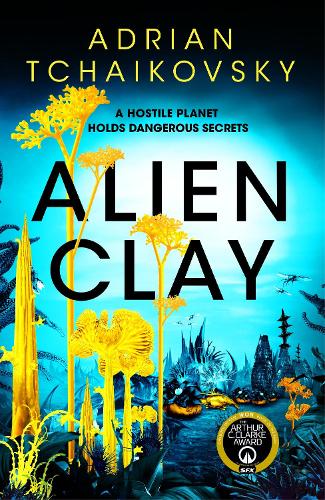
Alien Clay
Fiction, Science Fiction, Fantasy & Horror , Science Fiction & Fantasy
Adrian Tchaikovsky (author)
Hardback Published on: 28/03/2024
Price: £22.00