

Reviews: Agency (9)
“What if?”
(Hardback)
Agency takes us back to the universe William Gibson introduced us to in The Peripheral. A universe where it is possible to contact and interact with the past in a way that does not affect the present.
An all-action thriller where the present is trying to influence the past with the assistance of an emerging autonomous AI. Conspiracies abound and there are shadowy agencies working in the background. All against a backdrop of impending nuclear war.
There is gentle humour here as well and working from home never looked so easy.
The short chapters and the changes in point of view from present to past could have been a narrative mess in less skilled hands but William Gibson is a master storyteller who keeps all the strands from tangling leaving a story that moves with pace and characters you engage with.
“An AI comes of age in an alternate universe”
(Hardback)
William Gibson always works in trilogies, and Agency is the sequel to 2014's The Peripheral, and ends with some questions still to be answered in a hopefully forthcoming future volume. Gibson fans (like the Prime Minister's chief political adviser) will be reassured to note that his recurring techniques are all present and correct: short, punchy chapters focusing on alternating characters; a sceptical young heroine caught up in a vast, obscure conspiracy; and of course a razor-sharp dissection of where the current technological trajectory of society might be taking us. He's less cautious about making political pronouncements in this one: the central character Verity lives in a universe where Hillary Clinton is President of the US and Brexit never happened, and who wouldn't want to live in her world? There's also a really good Doctor Who joke on page 131. If you haven't read Gibson, you're missing out on the most influential SF writer since Wells; if you have, then you're probably already reading this.
“Jackpot!”
(Hardback)
I'm a huge fan of William Gibson (I've not got a collection of Neuromancer in different editions...) and am always waiting for his next book with great anticipation, waiting to see where he takes us next.
In Agency, he gives us a 'prequel and sequel' to The Peripheral.
Like The Peripheral the story of Agency switches between two different timelines, a 2017 where Verity lives in a world where Hilary Clinton won the 2016 elections, and the other is set in the 22nd century post-Jackpot world of Russian crime families and advanced technology.
Written in short punchy chapters switching between the two time frames, developing character depth and interaction which makes you invest very quickly and ensures that you don't want to put the book down. The explanation of the technology in the book works on extrapolations from existing technology so never really seems that far fetched.
Though the way interaction with 'stubs' is achieved is the most 'out there' technology mentioned it still doesn't jar and t hat's what I've always enjoyed about Gibson's writing, especially Blue Ant Trilogy and the Bridge Trilogy, the technology could be out there now, being developed and tested as it is never an outrageous use of 'black box' technologues.
Another great addition to William Gibson's oeuvre, and I'm now back to anticipating his next work.
“Dystopian time shift thriller set in LONDON and SAN FRANCISCO”
(Paperback)
San Francisco in 2017, and London in 2136. In San Francisco, Verity Jane is hired by a somewhat mysterious company to test drive a new form of AI. She communicates with ‘it’ through glasses and earpieces. It’s name is Eunice (a friendly name for an Untethered Noetic Irregular Support System – U.N.I.S.S.), and they soon build a relationship. Its avatar shows it is clearly female… Eunice becomes too clever and too advanced for her own good – she is paranoid and hides what she is doing from those who created her. They decide to take her down, but they fail. Eunice has designed a plan to survive such an eventuality. She splits into many units scattered around the world and waits to be reassembled.
Fast forward to London. A government agency needs to rewrite the past to prevent a disaster. They need to go back to San Francisco in 2017 and change the course of history. Only Eunice can help them achieve this. They have to track her down, and get her back operationally. Netherton and his wife, Rainey, are given the task – working for Lowbeer, ostensibly a Metropolitan Police Inspector, but in fact a great deal more… Technology has advanced – they can communicate with Verity Jane and Netherton can ‘appear’ in California in 2017 and Verity Jane can equally ‘appear’ in London in 2136. What follows is a very exciting and imaginative thriller as Verity Jane is pursued around California by the mysterious forces that created Eunice – and relies on entities that Eunice herself has designed to protect her. Drones controlled by the good guys out of Washington create havoc for the forces, all watched in ‘real time’ by those in London over 100 years into the future. Avatars, screens, and drones are everywhere.
Agency, apart from being an exceptionally exciting thriller, is also a book that makes you ponder what the future may hold. The amazing technology is in some ways an extrapolation from today’s cutting edge ideas, and in some ways a result of the imagination of William Gibson. William is credited with the creation of the term ‘cyberspace’ and is someone who envisioned both the internet and virtual reality before either existed. He is hailed as one of the great thinkers of our generation. His envisioning of London in 2136 is quite remarkable.
Agency is a book very well worth reading.
“Observe, orient, decide, act”
(Hardback)
I'm grateful to the publisher for a free advance e-copy of Agency via NetGalley.
Sequel to Gibson's The Peripheral, Agency is a book that can be read as a standalone, although that leaves the reader with a a job of catching up to do. Still, we are brought up to speed pretty quickly.
The book takes place across three alternate timelines - our world, albeit in 2136, and two versions of 2016, including one where the results of the UK's Brexit referendum and of the US's presidential election were different. With its events taking place in San Franciso, the latter timeline gives some quiet signs of hope in the US: a mural celebrating "the President's" courage, for example ('Her opponent loomed behind her, as he once actually had'). We don't see the outcome in the UK in this scenario. But Gibsons insists that people are generally no happier, not knowing what they've been saved from - and the "jackpot", a horrible future featuring decades of catastrophe, is still coming. Nothing immediately hangs on the difference in political outcomes and we don't see the longterm effects. Rather the conflict that motivates the book takes place under the radar and at a more personal level.
Gibson's conceit is that "our" timeline is the "real" one from which the others are "stubs", branches formed when somebody in "our" world communicates back to inhabitants in the distant past.. How such communication is possible isn't explained (I think that's where reading The Peripheral, which I hadn't, may help) but Gibson uses the idea with gusto, having the inhabitants of 2136 London intervene in 2016 for a variety of reasons - one is malicious and enjoys causing trouble, others see it as a hobby, while our main protagonists - a Detective Inspector Ainsley Lowbeer and her sidekick, Netherton - seek to help. In particular, they're trying to prevent alt-2016 perishing in a nuclear war, and therefore seek traction in that world. (This is challenged by an indignant resident of one of the other timelines as simply colonialism)
At the other end of this process is Verity Jane, a young woman renowned in the tech world as the "app whisperer" and in the tabloids as Stetson Howell's ex. Howell is a powerful force in tech and having broken ups with him, Verity is of great interest to social media. When the book opens she's just about to take a new job evaluating an AI personal assistant for startup Tulpagenics - something that will change her life for ever.
The AI, Eunice*, becomes key to this story and the relationship between it - her - and Verity both touching and intriguing. As chapters alternate between San Francisco and London, we gradually see a more complete picture of what's going on, but to achieve that you need to get your head round some complicated setups involving tele-presencing between the two timelines (and occasionally, all three).
So you can have a character (generally Netherton) living in 2136 London but virtually occupying a drone in 2016 alt-San Francisco, interacting with the inhabitants there and observing that reality through a game-like interface while occasionally exchanging words with someone with him in the (2136) - the conversation also including other characters who are effectively dialled in to the events, from one or other of the timelines. I found it really confusing at times ('...his phone's feed provided by her device's camera. She couldn't see him, though he could show her what he was seeing'), and the descriptions of what was being seen on that virtual display sometimes took a lot of effort to interpret.
There is also a lot of tech speak. 'She's an intermittently hierarchical array, complexly coterminous' for example, or 'a locus of clonic indeterminacy' or 'competitive control areas'. The book is in one sense a lot of extended conversations, undertaken as characters run for their lives. But, new words to learn! At least now I know what "noetic" means.
I realise this may sound as if I didn't like the book. That's not so at all. I really enjoyed Agency and look forward to reading more Gibson. The stuff above doesn't really hold up the narrative or make the essentials hard to follow. And he has some mind-bending concepts - see the character who has had her animated tattoos removed and installed into the hide of an indoor yurt, so that as she sleeps she's surrounded by moving animal figures. Or the idea of an electronic privacy filter created by a circle of dancing bots swirling shawls made of a smart fabric. And there is some really smart, even beautiful use of language here ('Her eyes and chartreuse lips seemed to float there, a disembodied Cheshire goth...', '"...something like Uber," Eunice said, "but for following people"', 'that horror movie feel of any unoccupied cam feed').
Above all, the characters feel real, part of a community, a family, at home ion their places - whether that's Verity sofa-surfing in San Francisco or Netherton with his wife Rainey and his son of even Lowbeer in her preposterous mobile situation room. The book feels deep, these characters care for each other, they have history and have made compromises and they know better to raise certain issues or to do certain things, and Gibson communicates all this subtly, he shows it, for which I can forgive him any amount of tech speak and mind-bending multi-way situations.
It was great fun. But do read The Peripheral first.
*Untethered Noetic Irregular Support System
Page of 2
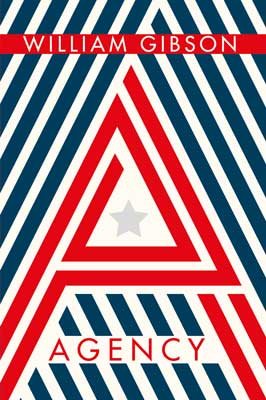
Agency
Fiction, Science Fiction, Fantasy & Horror , Science Fiction & Fantasy
William Gibson (author)
Hardback Published on: 23/01/2020
Price: £18.99