

Posted by Thomas Williams on August 18th, 2022
We tend to imagine that there is something inevitable, something immutable, about the circumstances into which we are born. I, for example, grew up in a world in which the UK was a core component of the European Union and in which Scotland was attached by an unshakeable bond to England, Wales and Northern Ireland. A world in which the collapse of the Soviet Union offered the promise of a new, liberal, democratic order in the emancipated nation states of eastern Europe and central Asia. A world in which the USA possessed total economic dominance, enviable political stability and an unwavering commitment to democratic values. No one envisaged a devastating banking crisis. No one seriously entertained the idea that brutal militaristic authoritarianism and genocidal warfare could return to Europe on such a scale. No one imagined the catastrophe of a viral pandemic that would claim more than six million lives and wreak havoc on the global economy.
And yet here we are. In the last fifteen years, all of the certainties with which I grew up have been thrown into question or altogether exploded. No one knows where things will go from here, what shapes they will ultimately take. One thing is certain: the world won’t look the way that I – as a child – unthinkingly assumed it always would. But whatever direction the world does ultimately take will be shaped by many competing human impulses – by the desire to preserve and restore, to mythologize and romanticize, to forge creative new paths, to tear up past strictures, to find radical solutions.
For anyone who grew up in Britain in the last decades of the fourth century, it must have seemed that the Roman Empire would form the eternal backdrop to their lives and the lives of their children – just as it had their parents, their grandparents and all of their ancestors for almost four centuries. There is no way that anyone born in the 380s could have imagined that they might die in a world cut off from Roman coins and Roman produce; where the grand public buildings and handsome stone townhouses of their youth were already falling into ruin; where the statues of emperors gazed sightlessly over public spaces filling inexorably with fetid floodwater, animal carcasses, weeds and shit; where strangers speaking foreign tongues and wielding wicked swords and praising unknown gods roamed the hills and highways, setting up farmsteads wherever they wished and lording it over the locals.
Those who experienced the collapse of Roman authority and urban economy in Britain at the end of the fourth century had hard choices to make, and the solutions they found gave rise to myriad experiments in how to live in a post-Roman world – dozens of attempts to chart a course through troubled waters. Should they throw in their lot with new immigrant communities and embrace their seemingly strange customs and weird fashions? Should they cling on to the vestiges of Roman civilization and the Christian faith that the empire had seeded but never properly nurtured? Or should they find a third way, blending and bending the memory and material of multiple pasts and identities to forge a new present, a new way of belonging.
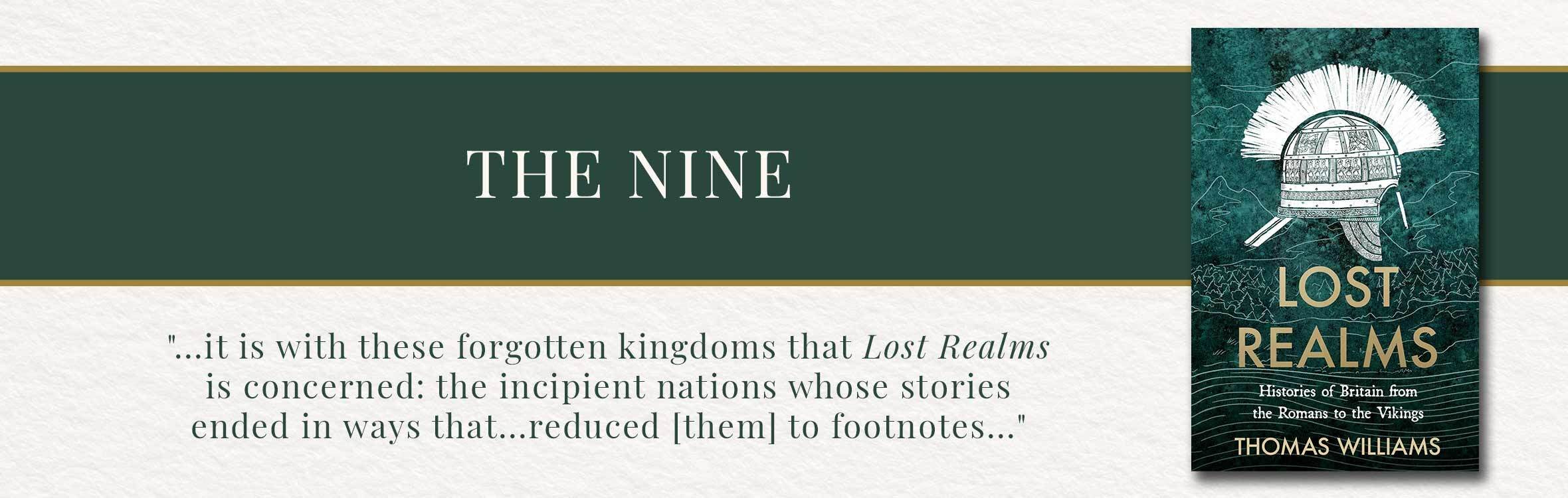
Some of these experiments gave rise to communities that prospered and flourished, developing by the seventh century into kingdoms of real heft. Those that made the cut still form part of our national story and live on in the imagination: Wessex, Mercia, Northumbria, Gwynedd, East Anglia. Others – the lightweight, the dysfunctional and the unlucky – burned out or faded away, leaving little trace. It is with these forgotten kingdoms that Lost Realms is concerned: the incipient nations whose stories ended in ways that left them by the side of the historical highway, reduced to footnotes or barely mentioned at all. Nine realms – ‘nine for mortal men doomed to die’ in Tolkien’s deathless words – whose outlines shimmer wraith-like on the wrinkled skin of this old island.
ELMET: a kingdom situated in Yorkshire’s West Riding that was extinguished by conquest almost as soon as it appeared in the historical record;
HWICCE: a kingdom of the Cotswolds and the vales of Gloucester and Evesham that was stripped of independence and swallowed whole by the bloated kingdom of Mercia;
LINDSEY: a marsh-bound kingdom of north Lincolnshire that was alternately dominated by the kings of Northumbria and Mercia before falling permanently under the shadow of the latter;
DUMNONIA: a realm comprised of Cornwall and Devon that was dismembered and ultimately broken by an aggressive kingdom of Wessex;
ESSEX: a kingdom of Essex, Middlesex and southern Hertfordshire that should have been a contender, but whose political and religious indecision made it vulnerable to predatory powers;
RHEGED: a mysterious kingdom that might never have existed at all but which, if it did, straddled the Solway Firth to flame brightly, if briefly, as the mighty realm of Urien Rheged;
POWYS: a kingdom of the Welsh hills and the west Midland plain whose princes crafted for themselves and their dwindling land an illustrious heritage that may have had little foundation in truth;
SUSSEX: an embowered and isolated realm of dark sorcery and heathen kings that was avoided and ignored until the swift obliteration of its culture at the hands of Northumbrians, West Saxons and Mercians;
FORTRIU: a Pictish realm of north-east Scotland whose culture came to dominate its neighbours to such a degree that its own identity was forgotten within the body of a greater Pictish kingdom – a kingdom that was itself doomed to fall in the fires of the Viking Age.
The stories of these nine realms help us to think about the many other paths that history might have taken, the shape of things that never came. They remind us too of the transience, the fragility, of the supposed order imposed by humans and their cultural foibles: political geography, ethnic identity, borders, dynasties, religions – even languages. The boldest experiments fail and the most self-confident nations wither, and all, in the words of an anonymous Old English poet, will ultimately be lost to shadow: ‘dark under night’s helm, as if it had never been’. This is the lesson that the Lost Realms offer to us: that not only will the status quo never hold, but what comes after will falter in its turn – for better or for worse.
Lost Realms by Thomas Williams is published by HarperCollins on August 18, 2022

