Posted by David Kynaston on September 3rd, 2021
The great French historian Fernand Braudel popularised the term the ‘longue durée’, and there have certainly been phases researching and writing my Tales of a New Jerusalem when it has felt like a very long duration. The original idea for an overarching, thickly textured and predominantly social history of Britain between 1945 (the Labour landslide which enabled Clement Attlee’s government to create the post-war settlement) and 1979 (when Margaret Thatcher entered Downing Street determined to reverse much of that settlement) came to me in 1987. This was when her third election victory confirmed unequivocally that 1979 represented a clear line in the historical sand – and that therefore 1945 to 1979 had its own distinctive narrative arc as a fully-fledged, self-contained story. I then in practice spent most of the 1990s writing a four-volume history of the City of London, before in due course, from 2007 onwards, Austerity Britain, Family Britain and Modernity Britain took my project up to June 1962.
That was achieved by 2014. At which point, not wanting to get stale, I took a break and wrote or co-wrote books on several other subjects, most enjoyably on cricket. But since 2019 I have been back on the case, and by March last year was ready to start writing the intended next big volume, Opportunity Britain, to go through to 1967. Two things then happened. First, of course, the pandemic, with the closure of physical libraries one of its lesser – though to me important – consequences; and second, the belated realisation that 5 October 1962 marked in some sense the start of the ‘real’ Sixties, given that on that Friday not only did the Beatles release their first single (‘Love Me Do’), but the first James Bond film (Dr No) had its premiere. Beatles and Bond: hard in truth to come up with any more iconic figures than those; and though naturally other starting dates are possible for that semi-mythical phenomenon we know as the Sixties, I think mine is at least as plausible as any.
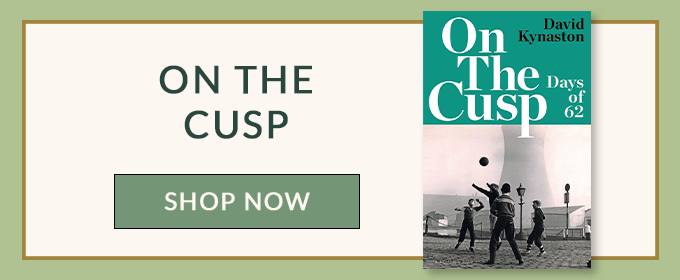
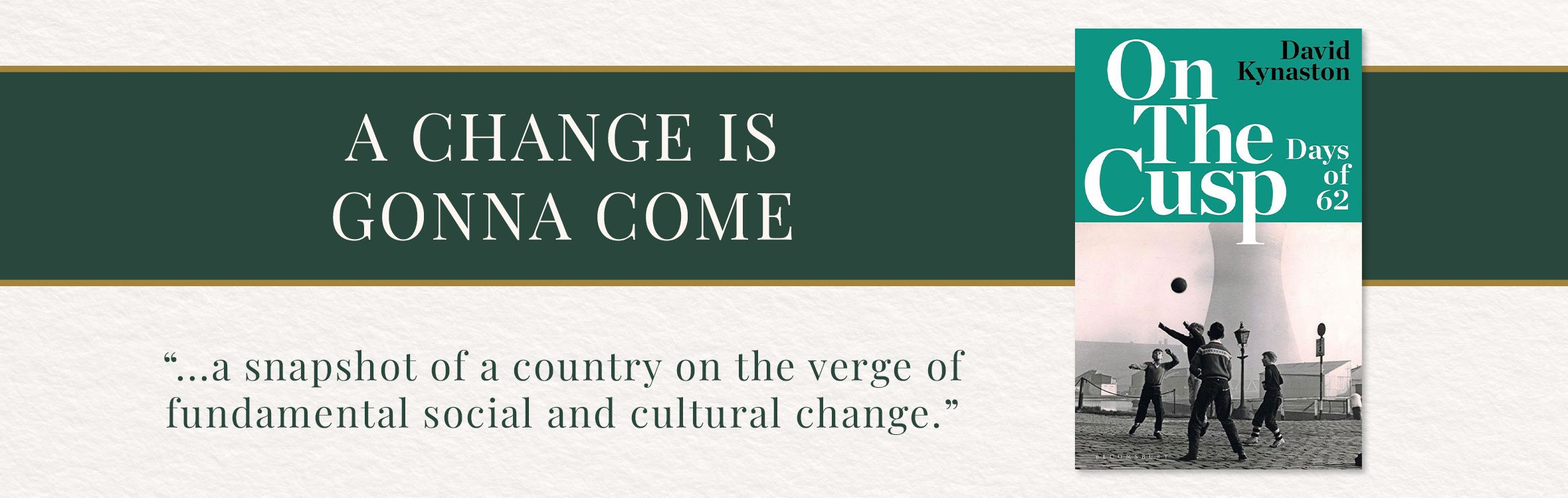
The result, helped by fortunately already having abundant material for 1962, is On the Cusp: a shortish book which, while partly a narrative of the four eventful months from June to October that year (relying as usual on an array of contemporary diarists and other eye-witnesses), is also a snapshot of a country on the verge of fundamental social and cultural change. The rural experience, the Welsh experience and the immigrant experience – all of them aspects relatively underplayed earlier in my sequence – are given detailed treatment; the pilots of That Was The Week That Was (finally hitting our TV screens in November 1962) are cue for a consideration of who comprised on the one hand the traditional Establishment, on the other hand the emerging liberal Establishment; and the book more or less ends with a gallery of what the decade’s future movers and shakers were up to in October 1962, often little guessing how their lives were about to be turned upside down.
Do I have a particular favourite moment from these months? Plenty of candidates, but one that always makes me smile occurred in August, as the diarist Judy Haines and her teenage daughters travelled from Chingford to Folkestone to see off a French pen-friend who had been to stay with one of the daughters. Judy records Danielle’s last words, shouted across from the jetty as she was about to catch the ferry: namely, ‘My boomerang won’t come back!’ – a nod to Charlie Drake’s recent novelty hit. Certainly not a moment of significant ‘high’ history; not really even a moment of significant ‘low’ history; but somehow emblematic of a time which in many ways, now in 2021, seems incredibly and touchingly distant.