Posted by Edward Dusinberre on November 18th, 2022
At the age of eleven I became a pupil at Chesterton School (now Community College) in Cambridge, a comprehensive school that enjoyed, at that time, a fairly rough reputation. I hadn’t been there long when I glanced out of a classroom window to see our geography teacher being chased down the driveway by a dangerous-looking fifth-year pupil. Keeping a low profile was prudent at a school where bullying was prevalent, and discipline a challenge for those teachers who displayed any hint of vulnerability. In an environment where any distinguishing feature – race, accent, sexual orientation, dress sense, unusual surname – was considered fair game for satire, being inconspicuous was a goal I attained most often during football games. Even then my efforts could be spoiled, the sports teacher pointing out my neck ‘hickey’ to the whole class with a salacious wink: ‘Playing the violin – looks like a rough sport to me!’
Nonetheless, there were plenty of teachers who encouraged individual expression. Rex Freeman, an English teacher who could just as well have belonged in a long-established repertory theatre, put on lively plays each year. At the age of thirteen I must have been one of the youngest ever actors to attempt Harold Twine, the sheepish husband in Ben Travers’s 1920s farce, Rookery Nook. Non-conformity came at a price, an early attempt at romance scuppered when the girl who was the focus of my bumbling ardour announced that my hairstyle was too embarrassing – perhaps a more general concern conveniently attributed to the middle parting and slicked-back hair that I had assumed for the role.
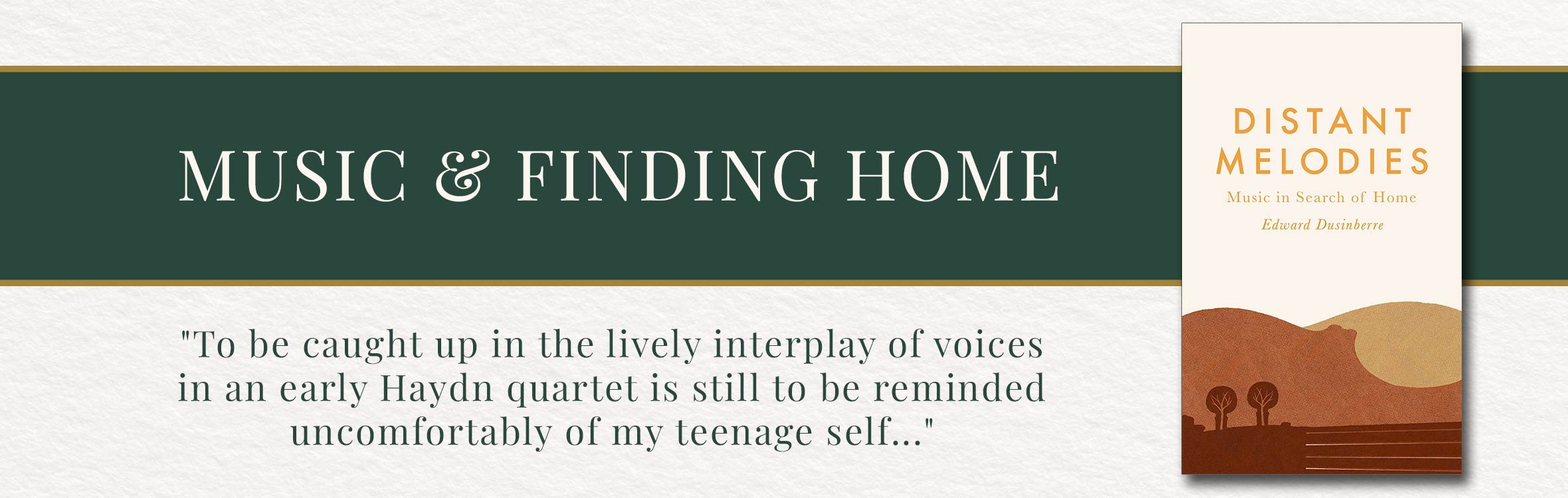
Chesterton boasted a thriving music programme run by the indefatigable Roger Bond, his name a source of relentless jokes during the era when Roger Moore played the principal part in the James Bond films. Displaying Bondian ingenuity and stamina, Mr Bond accommodated anyone who wanted to play an instrument, forming smaller chamber groups, orchestras, choirs and an impressive number of recorder ensembles. My Chesterton string quartet rehearsed twice a week before school in one of the dank huts close to the school’s entrance that had been built as temporary classrooms but somehow became permanent. To be caught up in the lively interplay of voices in an early Haydn quartet is still to be reminded uncomfortably of my teenage self. The transparent textures that expose differences in type of sound, phrase shapes and bow-strokes make Haydn a great choice for a beginner quartet, but on one occasion I reduced our second violinist to tears with an impatient outburst as she struggled to execute a difficult rhythm. Our violist scolded me for intolerant behaviour, an early lesson in the demands of a string quartet, where accountability to three other people was not restricted to one’s violin playing.
When I was sixteen years old, I learned the second violin part of Dvořák’s ‘American’ Quartet, with a string quartet comprised of players from the Cambridge Youth Orchestra. Once a month, fellow violinist Bill Hawkes picked up violist John Bass, cellist Richard Beales and myself from our respective homes and drove us one hour south on the M11 to Harlow to be coached by Bill’s and my violin teacher: Howard Davis, first violinist of the Alberni Quartet. Independence from parental supervision was joyfully affirmed by Bill’s occasional bursts of first-violinist acceleration as he swerved in and out of the fast lane in a red Volkswagen Golf, passing sluggish lorries with a derisive grin.
During one coaching I thought we were conveying adequately the excitement of the final movement until Howard urged John and me to begin the movement with crisper bow-strokes, exaggerating the snapped effect of a dotted rhythm. Played in this way, the second violin and viola provided an irresistible impetus that goaded the first violin to join the party a couple of bars later, with a tune that skipped along to the same rhythm. It was Howard who first told me about Dvořák’s love of trains, this repetitive rhythm perhaps an evocation of the journey that he had taken with his family in June 1893 from New York, on his way to spend the summer in the small Czech immigrant community of Spillville, Iowa. The vitality of Dvořák’s music, Howard’s teaching and the rowdy din that we made driving to his house contributed to an early experience of string quartets as a liberation from the constraints and anxieties of school life.
Distant Melodies: Music in Search of Home by Edward Dusinberre was published by Faber on November 3rd, 2022 (£18.99 hardback)