

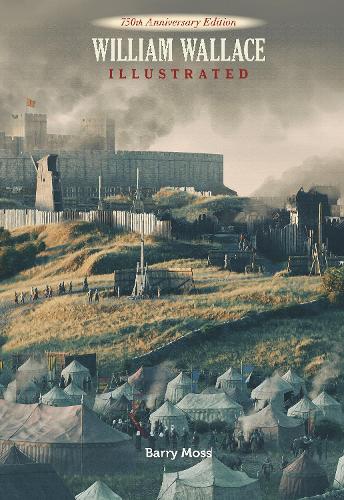
William Wallace Illustrated
Synopsis
This book is about William Wallace (c1272-1305), the most famous hero of the Scots and the period he lived in, from Alexander III to King Robert I (the Bruce). He was true to his cause and never a turncoat like so many of the earls and bishops. It is not only a history of those times and his endeavours to strive for independence from the English, but also an architectural journey following in his footsteps to those places where he travelled that still exist today, which are of considerable interest. I have also drawn many measured plans so the significance of the scale of the buildings can be clearly gauged. I have put together all the relevant information I could find of the period within this book, although I have not made a determination on all these findings as I am in my ninth decade and have other work to complete. There is much more information for the student to derive from what is contained herein and, where in doubt, to also challenge my determinations. William’s father, Alan, was born in Richard Town, Province of Kyle (Ayrshire) in c1250 and Alan, on the death of his father, Adam, inherited the £5 lands of Ellerslie in Ayrshire, whilst his elder brother, Richard, inherited the estate. The centre of the estate of Richard Town, owned by the Wallace family and also known as Rickartoun, or Riccarton, lay in a fertile valley to the west of Caprington. Ellerslie also lay in Ayrshire and probably close to the Richard Town estate for easy management. The present (North) Riccarton on the south side of Kilmarnock is a separate community, although it may have been the northern periphery of the Richard Town estate.
William was born in c1272, at which time Edward ascended to the throne of England. William was of noble blood, mostly through the female line of the family: his great-grand- mother, Margaret Buckingham, was the daughter of the Earl of Buckingham and Lady Sibil of Vesey and, through them, a descendant of Yngvar, King of Denmark, mentioned in the Saxon Chronicles; his grandmother, Eupheme, was the daughter of Walter Stewart, 3rd High Steward of Scotland, and Bethoc and, through them, a descendant of the Dukes of Brittany and Normandy and the earls of Northumbria and Huntington; his aunt, Lady Helen Bruce, was a daughter of Isabella and Robert of Brus, who laid claim to the throne of the Scots in 1291 and whose grandson, Robert of Bruce, became King of the Scots in 1306.
At the time of Wallace’s birth Alexander III of the Scots had been on the throne for 23 years and he died when Wallace was aged fourteen. He was a brave, wise, loved and respected king, by both the Scots and English, having married Margaret, daughter of Henry III. He won the Hebrides from the Norwegians and acquired the Isle of Man from them. Alexander was succeeded by Margaret, maid of Norway, and her short reign of 4 years was followed by another 4 years by King John, commencing in 1292. There was much controversy during his selection as monarch and during his deposition in 1296, when Wallace was 24. Wallace would have been much aware of these turbulent times.
There is no documentation that would reveal where or in what manner Wallace was educated. The mostly fictional account of Blind Harry (c1440-1492) says Wallace went to Paisley Abbey for his primary education and to Dundee thereafter. This information Harry (or Hary, or the Minstrel Henry) implied he obtained from William Wallace of Craigie (c1415-1479), who inherited the estate from his ather, John, in 1447. As William died in c1479, this would have been the latest date by which Harry would have obtained the information from him for his 12-volume poem or ballad TheActsandDeedsoftheMost IllustriousandValiantChampionandScholarWilliamWallace. There is good reason to suppose that Harry served in the military and, if this is the case, then he would not have commenced his book until the 1460s; since the earliest known edition of the book is 1488, his work commenced at least 160 years after the death of William Wallace.
It is credible that William Wallace attended Paisley Abbey, as the charter for it was witnessed by an ancestor, Richard Wallace. It is most likely that from here he went to Dundee for further education during his most impressionable years. He is known to have been in the general area, for he was referred to in court in Perth concerning the theft of a keg, or barrel, of beer. Further, when a Guardian of the Scots, he chose to possess the lands of Dundee Castle, in his old town, when he could have had a number of other sites. Wallace became a “chief of brigands” and his weapon of choice was the bow and arrow, as depicted on his seal.
- • We hear of William Wallace of certainty when he is attacking the Sheriff of Clydesdale at Lanark, presumably in its castle, of which the earthworks still remain. This is probably the most singular act that provided the impetus for independence of the Scots. Why Wallace attacked the sheriff is unknown and, once again, I refer to Blind Harry for a plausible reason when he states the sheriff was the cause of dishonour to his girlfriend. It is quite amazing what people will do when in love. A rare eye-witness account of the attack is given by the future knight, Thomas Gray, when a teenager, in his son’s book as mentioned herein. A detailed account of the war that Wallace and the community of the Scots made for independence, and other matters of his times, are contained in the following pages. Of note are the following, some of which have been found for the first time, or re-discovered:
- • *The location of the estate of Richard Town (Riccarton) in Ayrshire.
- • *That Wallace was of noble blood and from Ellerslie in Ayrshire.
- • *That it was Robert of Brus, grandfather of King Robert I, through his claim to the throne of the Scots, that instigated the involvement of King Edward I in deciding the rightful heir.
- • *That William de Hesilrig, although he was slain at Lanark, was the Sheriff of Clydesdale, a much larger region.
- • *After his slaying of the Sheriff at Lanark, Wallace’s popularity was such that Robert Wishart, Bishop of Glasgow, and James Stewart, Steward of Scotland, encouraged and, probably, initially financed the further exploits of Wallace. Wishart was resentful of the superiority of the Archbishop of York over the church in Scotland and steered Wallace to attack those religious houses controlled by English clerics.
- • * That after the attack at Lanark, Wallace gathered with his men in Selkirk Forest.
- • * The location of the motte-and-bailey castle in Dundee and that it had been formerly owned by Sir William Wallace and by his descendants until C19th. This is the only land that Wallace is known to have owned.
- • * The bridge over the Forth near Stirling where the battle took place was more likely to have been at Cambuskenneth, where the crossing was much narrower and a monastery was nearby.
- • * That the famous Wallace letter to “the mayors and commonwealth of Lubeck and Hamburg” was written from Bassington in Northumberland, and not Haddington.
- • * The original name of Hexham was Hagustald, the name of a warrior from Kjolvik, Rogaland, Norway.
- • * A witness account of Wallace at Hexham Abbey.
- • * Wallace was knighted between leaving Hexham after 7th November, 1297 and being at Torphichen Preceptory on 29th March, 1298.
- • * Sir William Wallace was reported as leaving Scotland on 19th August, 1299, by which time his elder brother Malcolm had been knighted.
- • * Sir William Wallace was captured at night on 4th March, 1305 by Sir John de Menteith whilst his lover slept by his side. Wallace’s whereabouts were revealed by Jack Short. Jack’s brother was the servant of Wallace and was slain. Wallace was captured in the house of Raw Rae at Robroyston, near Glasgow, the probable descendant of whom cast the dies of his seal in 1912.
- • * Wallace was brought to London on Sunday, 22nd August, 1305 and stayed at the house of William de Leyre. The next day Wallace travelled on horseback to Westminster, standing trial that day.
- • * Contemporary documents herein give an account of the trial of Wallace, his punishment and payments to his captors.
- • * In the week following Easter Day, 26th March, 1307, Sir John Wallace, younger brother of William, was captured and taken to the king in Carlisle, where he had held parliament. John was chained and sent to London on a hackney (horse) and befell the fate of his brother. Fourteen weeks later, on 7th July, 1307, King Edward died and here ends this account.
Publisher information
- Publisher: HEATHER PUBLISHING LTD
- ISBN: 9781666410587
- Number of pages: 384
- Dimensions: 297 x 210 mm