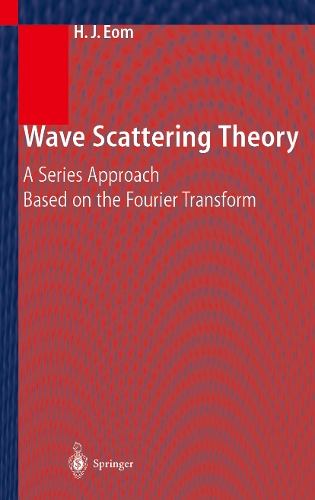
Wave Scattering Theory: A Series Approach Based on the Fourier Transformation
Synopsis
The Fourier transform technique has been widely used in electrical engineer ing, which covers signal processing, communication, system control, electro magnetics, and optics. The Fourier transform-technique is particularly useful in electromagnetics and optics since it provides a convenient mathematical representation for wave scattering, diffraction, and propagation. Thus the Fourier transform technique has been long applied to the wave scattering problems that are often encountered in microwave antenna, radiation, diffrac tion, and electromagnetic interference. In order to u~derstand wave scattering in general, it is necessary to solve the wave equation subject to the prescribed boundary conditions. The purpose of this monograph is to present rigorous so lutions to the boundary-value problems by solving the wave equation based on the Fourier transform. In this monograph the technique of separation of vari ables is used to solve the wave equation for canonical scattering geometries such as conducting waveguide structures and rectangular/circular apertures. The Fourier transform, mode-matching, and residue calculus techniques are applied to obtain simple, analytic, and rapidly-convergent series solutions. The residue calculus technique is particularly instrumental in converting the solutions into series representations that are efficient and amenable to nu merical analysis. We next summarize the steps of analysis method for the scattering problems considered in this book. 1. Divide the scattering domain into closed and open regions. 2. Represent the scattered fields in the closed and open regions in terms of the Fourier series and transform, respectively. 3.
Publisher information
- Publisher: Springer-Verlag Berlin and Heidelberg GmbH & Co. KG
- ISBN: 9783642639951
- Number of pages: 244
- Dimensions: 235 x 155 mm
- Languages: English
Customer Reviews
You may also like...