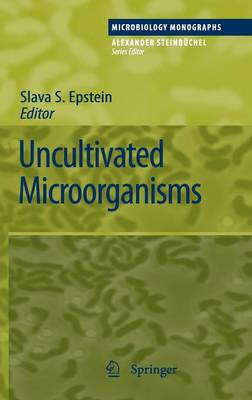
Uncultivated Microorganisms
Synopsis
In 1898, an Austrian microbiologist Heinrich Winterberg made a curious observation: the number of microbial cells in his samples did not match the number of colonies formed on nutrient media (Winterberg 1898). About a decade later, J. Amann qu- tified this mismatch, which turned out to be surprisingly large, with non-growing cells outnumbering the cultivable ones almost 150 times (Amann 1911). These papers signify some of the earliest steps towards the discovery of an important phenomenon known today as the Great Plate Count Anomaly (Staley and Konopka 1985). Note how early in the history of microbiology these steps were taken. Detecting the Anomaly almost certainly required the Plate. If so, then the period from 1881 to 1887, the years when Robert Koch and Petri introduced their key inventions (Koch 1881; Petri 1887), sets the earliest boundary for the discovery, which is remarkably close to the 1898 observations by H. Winterberg. Celebrating its 111th anniversary, the Great Plate Count Anomaly today is arguably the oldest unresolved microbiological phenomenon. In the years to follow, the Anomaly was repeatedly confirmed by all microb- logists who cared to compare the cell count in the inoculum to the colony count in the Petri dish (cf., Cholodny 1929; Butkevich 1932; Butkevich and Butkevich 1936). By mid-century, the remarkable difference between the two counts became a universally recognized phenomenon, acknowledged by several classics of the time (Waksman and Hotchkiss 1937; ZoBell 1946; Jannasch and Jones 1959).
Publisher information
- Publisher: Springer-Verlag Berlin and Heidelberg GmbH & Co. KG
- ISBN: 9783540854647
- Number of pages: 208
- Dimensions: 235 x 155 mm
- Languages: English
Customer Reviews
You may also like...