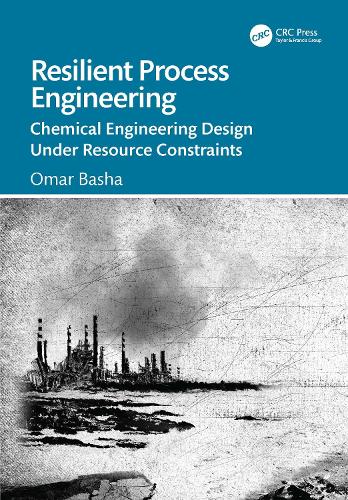
Resilient Process Engineering: Chemical Engineering Design Under Resource Constraints
Synopsis
Chemical Engineering is typically taught as if the world will cooperate: instruments are calibrated, utilities are stable, spares arrive on time, and a “better model” is always just one more week of work away. In practice, the problems that matter most, safety, health, reliability, and continuity of service, rarely show up with ideal data or ideal conditions. Resilient Process Engineering is a scenario-driven text that examines how Chemical Engineers work effectively in the real world, applying fundamental chemical engineering principles under constraints and how those fundamentals support sound decisions in less than ideal circumstances. It combines rigorous calculations with realistic field situations, maintenance logic, risk thinking, and practical deliverables, giving readers a coherent systems context while preserving technical depth and discipline.
- Covers core chemical engineering tools through constrained, utility-scale problems, presenting information via a recurring theme of applying chemical engineering first principles under constraints.
- Integrates topics normally taught in separate books (balances, fluids, heat transfer, mass transfer, separations, bioprocesses, control, process safety, and reliability) into one coherent systems narrative built around resource-constrained operation.
- Features example scenarios with real-world analogs throughout, including disaster recovery, rural and small-system utilities, remote industrial camps, off-grid research stations, commissioning and startup, equipment aging and corrosion, supply-chain interruptions, and understaffed operations.
- Each chapter includes a casefile (the core lesson), scenario brief, core theory applied, worked examples, common pitfalls, realistic datasets, problems, and a deliverables kit (a professional-style deliverables template with examples).
- Shows how to apply critical principles to solve chemical engineering problems including system boundaries, conservation laws, dominant physics, uncertainty bounds, and inherently safer design.
- Supplemented with engineering and calculation tools (Excel spreadsheets).
This book is written for a range of audiences within chemical engineering, including upper-level undergraduate and graduate students in chemical engineering, practicing chemical engineers including specialists who want a structured way to connect across domains, operators, technicians, and field engineers in small plants and utilities, and humanitarian engineering and disaster-response practitioners, where constraints are the baseline.
Publisher information
- Publisher: Taylor & Francis Ltd
- ISBN: 9781041400080
- Number of pages: 416
- Dimensions: 254 x 178 mm
- Languages: English
Customer Reviews
You may also like...