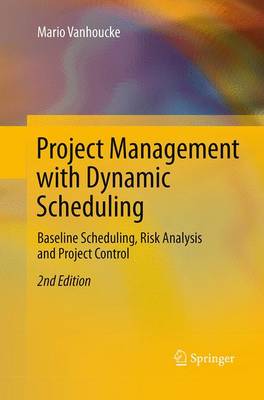
Project Management with Dynamic Scheduling: Baseline Scheduling, Risk Analysis and Project Control
Synopsis
The topic of this book is known as dynamic scheduling, and is used to refer to three dimensions of project management and scheduling: the construction of a baseline schedule and the analysis of a project schedule’s risk as preparation of the project control phase during project progress. This dynamic scheduling point of view implicitly assumes that the usability of a project’s baseline schedule is rather limited and only acts as a point of reference in the project life cycle. Consequently, a project schedule should especially be considered as nothing more than a predictive model that can be used for resource efficiency calculations, time and cost risk analyses, project tracking and performance measurement, and so on.
In this book, the three dimensions of dynamic scheduling are highlighted in detail and are based on and inspired by a combination of academic research studies at Ghent University (www.ugent.be), in-company trainings at Vlerick Business School (www.vlerick.com) andconsultancy projects at OR-AS (www.or-as.be). First, the construction of a project baseline schedule is a central theme throughout the various chapters of the book, and is discussed from a complexity point of view with and without the presence of project resources. Second, the creation of an awareness of the weak parts in a baseline schedule is discussed at the end of the two baseline scheduling parts as schedule risk analysis techniques that can be applied on top of the baseline schedule. Third, the baseline schedule and its risk analyses can be used as guidelines during the project control step where actual deviations can be corrected within the margins of the project’s time and cost reserves.
The second edition of this book has seen corrections, additions and amendments in detail throughout the book. Moreover Chapter 15 on "Dynamic Scheduling with ProTrack" has been completely rewritten and extended with a section on "ProTrack as a research tool".
Publisher information
- Publisher: Springer-Verlag Berlin and Heidelberg GmbH & Co. KG
- ISBN: 9783662521373
- Number of pages: 318
- Dimensions: 235 x 155 mm
- Languages: English
Customer Reviews
You may also like...