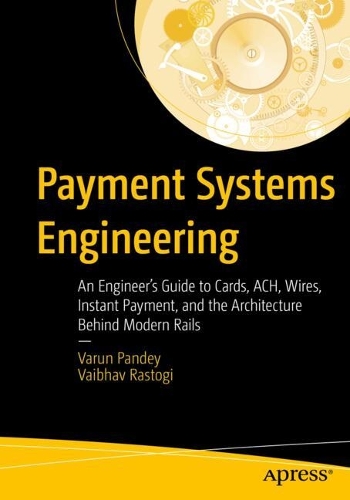
Payment Systems Engineering: An Engineer’s Guide to Cards, ACH, Wires, Instant Payment, and the Architecture Behind Modern Rails
Synopsis
This book is a production-oriented engineering book that explains how modern payment systems are designed, built, and operated. It covers every major rail that moves money — cards, ACH, wires, instant payments, and cross-border networks — and treats each not as a business abstraction but as a technical system with specific behaviors, failure modes, and correctness requirements that engineers must understand to build on top of them reliably.
Currently, there exists a clear gap in the engineering literature. Business overviews of payments exist in abundance, aimed at executives, product managers, and compliance professionals. Standard documentation exists for implementers of individual rails. What does not exist is a coherent, practitioner-written guide to how payment systems behave in production: how money flows through clearing and settlement, how failures propagate and must be handled, how ledgers are kept correct across distributed systems under partial failure, and how fraud detection, reconciliation, and operational controls are engineered as first-class architectural concerns rather than operational afterthoughts. This book fills that gap.
This book explains not just what payment systems do but why they are designed that way — and what these design implications are for engineers who build on top of them. The book is not tied to any specific technology stack. Its value is in the reasoning and principles that transfer across languages, frameworks, and institutions.
What You Will Learn
• How each major payment rail — cards, ACH, wires, RTP/FedNow, and cross-border networks — functions at the clearing and settlement layer, including timing windows, finality rules, and the specific conditions under which transactions return, reverse, or fail.
• How to design payment ledgers and transaction records that remain correct and auditable under the partial failures, retries, duplicate submissions, and race conditions that distributed payment environments routinely produce.
• How to engineer fraud and risk controls, exception-handling workflows, and reconciliation pipelines as core architectural components — not operational overlays added after the fact.
• How to apply a payment-specific engineering mindset to system design, encompassing regulatory constraints, counterparty trust boundaries, settlement risk, and the auditability requirements that distinguish payment platforms from general-purpose distributed systems.
• How to evaluate and work with emerging capabilities — payment orchestration, open banking APIs, and AI-assisted payment operations — with a grounded understanding of the infrastructure those capabilities depend on.
Who This Book is For
The primary audience is mid-to-senior software engineers, solution architects, and technical leads who are building or operating payment systems at financial institutions, fintech companies, or technology companies expanding into financial services. Readers are assumed to have a solid engineering foundation; the book teaches payment domain depth, not general programming. A secondary audience includes engineering managers and technical product leaders who need enough domain fluency to make sound architecture and investment decisions, and advanced students in computer science, financial engineering, or applied mathematics who are entering financial technology roles.
Publisher information
- Publisher: APress
- ISBN: 9798868831614
- Dimensions: 254 x 178 mm
- Languages: English
Customer Reviews
You may also like...