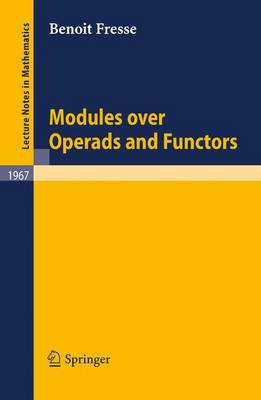
Modules over Operads and Functors
Synopsis
The notion of an operad was introduced 40 years ago in algebraic topology in order to model the structure of iterated loop spaces [6, 47, 60]. Since then, operads have been used fruitfully in many ?elds of mathematics and physics. Indeed, the notion of an operad supplies both a conceptual and e?ective device to handle a variety of algebraic structures in various situations. Many usualcategoriesofalgebras(likethecategoryofcommutativeandassociative algebras, the category of associative algebras, the category of Lie algebras, thecategoryofPoissonalgebras,...)areassociatedtooperads. The main successful applications of operads in algebra occur in defor- tion theory: the theory of operads uni?es the construction of deformation complexes, gives generalizations of powerful methods of rational homotopy, and brings to light deep connections between the cohomology of algebras, the structure of combinatorial polyhedra, the geometry of moduli spaces of surfaces, and conformal ?eld theory.
The new proofs of the existence of deformation-quantizations by Kontsevich and Tamarkin bring together all these developments and lead Kontsevich to the fascinating conjecture that the motivic Galois group operates on the space of deformation-quantizations (see [35]). The purpose of this monograph is to study not operads themselves, but modules over operads as a device to model functors between categories of algebras as e?ectively as operads model categories of algebras. Modules overoperads occur naturally when one needs to representuniv- sal complexes associated to algebras over operads (see [14, 54]). Modules overoperads havenot been studied as extensively as operads yet.
Publisher information
- Publisher: Springer-Verlag Berlin and Heidelberg GmbH & Co. KG
- ISBN: 9783540890553
- Number of pages: 314
- Dimensions: 235 x 155 mm
- Languages: English
Customer Reviews
You may also like...