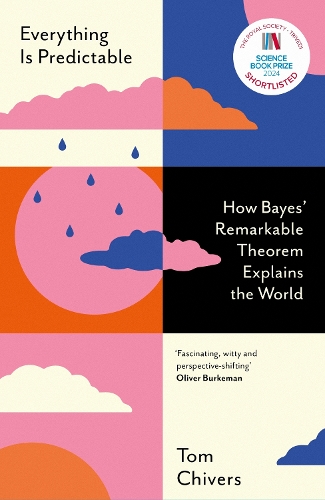
Everything Is Predictable: How Bayes' Remarkable Theorem Explains the World
Synopsis
Thomas Bayes was an eighteenth-century Presbyterian minister and amateur mathematician whose obscure life belied the profound impact of his work. Like most research into probability at the time, his theorem was mainly seen as relevant to games of chance, like dice and cards. But its implications soon became clear.
Bayes' theorem helps explain why highly accurate screening tests can lead to false positives, causing unnecessary anxiety for patients. A failure to account for it in court has put innocent people in jail. But its influence goes far beyond practical applications. A cornerstone of rational thought, Bayesian principles are used in modelling and forecasting. 'Superforecasters', a group of expert predictors who outperform CIA analysts, use a Bayesian approach. And many argue that Bayes' theorem is not just a useful tool, but a description of almost everything - that it is the underlying architecture of rationality, and of the human brain.
Fusing biography, razor-sharp science communication and intellectual history, Everything Is Predictable is a captivating tour of Bayes' theorem and its impact on modern life. From medical testing to artificial intelligence, Tom Chivers shows how a single compelling idea can have far-reaching consequences.
Publisher information
- Publisher: Orion Publishing Co
- ISBN: 9781399604031
- Number of pages: 336
- Dimensions: 238 x 160 x 34 mm
- Weight: 530g
- Languages: English


You may also like...