

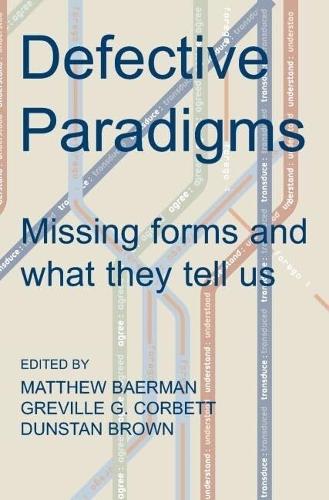
Defective Paradigms: Missing Forms and What They Tell Us
Synopsis
An important design feature of language is the use of productive patterns in inflection. In English, we have pairs such as 'enjoy' ~ 'enjoyed', 'agree' ~ 'agreed', and many others. On the basis of this productive pattern, if we meet a new verb 'transduce' we know that there will be the form 'transduced'. Even if the pattern is not fully regular, there will be a form available, as in 'understand' ~ 'understood'. Surprisingly, this principle is sometimes violated, a phenomenon known as defectiveness, which means there is a gap in a word's set of forms: for example, given the verb 'forego', many if not most people are unwilling to produce a past tense.
Although such gaps have been known to us since the days of Classical grammarians, they remain poorly understood. Defectiveness contradicts basic assumptions about the way inflectional rules operate, because it seems to require that speakers know that for certain words, not only should one not employ the expected rule, one should not employ any rule at all. This is a serious problem, since it is probably safe to say that all reigning models of grammar were designed as if defectiveness did not exist, and would lose a considerable amount of their elegance if it were properly factored in.
This volume addressed these issues from a number of analytical approaches - historical, statistical and theoretical - and by using studies from a range of languages.
Publisher information
- Publisher: Oxford University Press
- ISBN: 9780197264607
- Number of pages: 230
- Dimensions: 241 x 164 x 21 mm
- Weight: 542g
- Languages: English