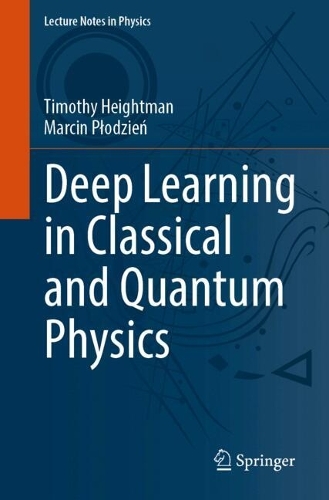
Deep Learning in Classical and Quantum Physics
Synopsis
This book provides an introduction to deep learning and its applications across the physical sciences, both in classical and quantum systems. Moving beyond a black-box approach, the text develops deep learning methods from first principles through a geometric perspective. Neural networks, generative models, and physics-informed methods—such as Physics-Informed Neural Networks (PINNs) and Neural Ordinary Differential Equations (NODEs)—are formally framed in the language of smooth manifolds and information geometry.
A central theme of the book is utilizing structures like Fisher information, the variational principle, and natural gradient descent to map deep learning directly onto physical dynamics. These concepts are extensively applied to the quantum systems, where large Hilbert spaces present unique computational challenges. Key topics include entanglement classification, quantum phases of matter discovery, quantum state tomography, and Hamiltonian learning for inferring system dynamics. The text further extends this information-geometric framework to the optimization of variational quantum algorithms in near-term quantum computing.
Designed for graduate and advanced undergraduate students in physics, mathematics, engineering, and computer science, the book emphasizes a fundamental understanding of what these models compute and where their limitations lie. Readers are expected to have a standard background in linear algebra, calculus, and introductory quantum mechanics. The text is structured to accommodate different disciplinary backgrounds, offering adaptable reading pathways to effectively integrate modern computational tools with physical theory.
Publisher information
- Publisher: Springer Nature Switzerland AG
- ISBN: 9783032356406
- Dimensions: 235 x 155 mm
- Languages: English
Customer Reviews
You may also like...