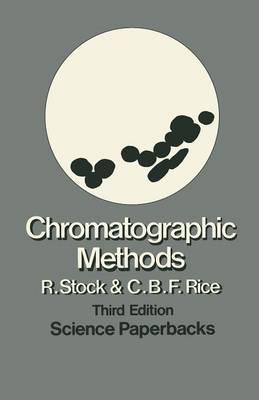
Chromatographic Methods
Synopsis
Classification of chromatographic methods Chromatography is the name given to a particular family of separation techniques of great effectiveness. The original method was described in 1903 by Tswett, who used it for the separation of coloured substances, and the name chromatog raphy stems from this. However, the limitation to coloured compounds never really obtained, and most chromatographic separations are nowadays performed on mixtures of colourless substances, including gases. Like fractional distillation, chromatography relies on the relative movement of two phases, but in chromatography one is fixed and is known as the stationary phase; the other is known as the mobile phase. Chromatographic methods may be classified first according to the nature of the mobile phase and, second, according to the nature of the stationary phase. The mobile phase may be a liquid or a gas, and the stationary phase may be a solid or a liquid. There are thus four main sub-divisions of the chromatographic process, as set out in Table 1.1. The system is called adsorption chromatography if the stationary phase is a solid, and partition chromatography if it is a liquid.
Publisher information
- Publisher: Chapman and Hall
- ISBN: 9780412208102
- Number of pages: 383
- Dimensions: 216 x 140 mm
- Languages: English
Customer Reviews
You may also like...