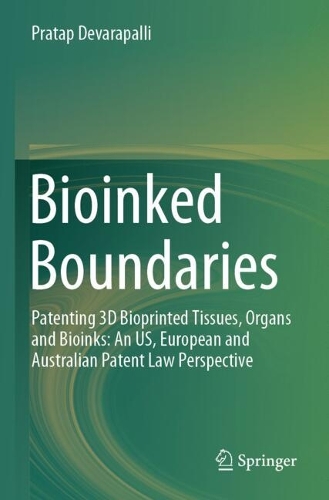
Bioinked Boundaries: Patenting 3D Bioprinted Tissues, Organs and Bioinks: An US, European and Australian Patent Law Perspective
Synopsis
This book presents a comprehensive and comparative study of the patentability of bioprinting inventions, specifically bioinks and bioprinted tissues, in the US, the Europe and Australia. It employs a two-phase analysis to understand, ‘Is the patentable subject matter requirement a hurdle to patenting bioprinting inventions, specifically bioinks and bioprinted tissues?’ The first phase is a doctrinal analysis of the patent laws and jurisprudence in respective jurisdictions, highlighting the similarities and differences in their approaches to the subject matter requirement. The second phase is an empirical analysis of the patent prosecution data from patent applications filed in each jurisdiction with claims directed towards bioprinted tissues and bioinks, revealing how patent examiners apply the patent provisions to accept or object to such patent claims.
The book offers several contributions to the field of bioprinting and patent law. First, it provides a detailed and up-to-date overview of the current state of the art and the legal landscape of bioprinting inventions. Second, it identifies the main criteria and factors that patent examiners use to assess the patentable subject matter of bioprinted tissues and bioinks, such as the level of human intervention, the markedly different characteristics, and the industrial applicability. Third, it proposes patenting framework models for each jurisdiction, which can assist patent applicants to draft and amend their patent claims in accordance with the patentable subject matter requirement. Fourth, it evaluates the potential benefits and implications of patenting bioprinting inventions for the bioprinting industry and society at large, such as fostering innovation, promoting public health, and indirectly addressing ethical and social issues.
The main benefit that the reader will derive from the book is a deeper understanding of the patentability of bioprinting inventions, specifically bioinks and bioprinted tissues, in different jurisdictions and contexts. The book will help the reader to appreciate the legal and technical aspects of bioprinting and patent law, and how they affect the bioprinting industry and society at large.
Publisher information
- Publisher: Springer Nature Switzerland AG
- ISBN: 9789819625932
- Number of pages: 193
- Dimensions: 235 x 155 mm
- Languages: English
Customer Reviews
You may also like...