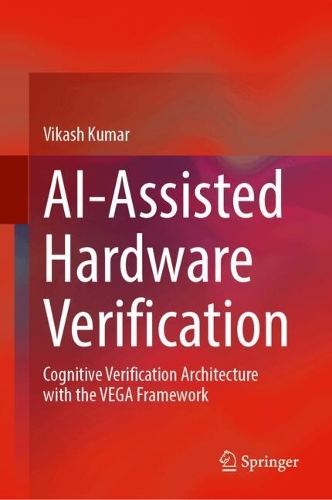
AI-Assisted Hardware Verification: Cognitive Verification Architecture with the VEGA Framework
Synopsis
This book offers a structured methodology for applying generative AI to the functional verification of complex semiconductor designs without sacrificing engineering accountability. It presents the VEGA framework—Verification Engineering through Guided AI—a complete verification lifecycle that treats AI as a governed accelerator, preserving traceability between design intent and verification evidence from specification through silicon sign-off.
Verification is the dominant schedule risk on most modern silicon programs. Modern SoCs contain billions of transistors and dozens of independently developed IP blocks, and large language models have rapidly entered hardware verification practice. Yet no comprehensive reference exists that explains how to integrate LLMs into industrial UVM-based verification flows with the rigor that pre-silicon engineering demands. This book closes that gap.
Across eight technical chapters, the book develops a complete methodology grounded in fifteen years of industrial verification practice. It introduces the Executable TestPlan as the central verification strategy artifact, a manifest-driven testbench architecture that governs AI-generated infrastructure, and scenario contracts for LLM-assisted test generation across functional, stress, and fault-injection categories. It reframes debug as classification anchored to design intent, extends the framework to subsystem verification through the Subsystem Intent Graph for cross-IP integration, and reconstructs verification sign-off as an evidence-based argument. The book closes with a ten-metric quality suite organized into three families—generation-side (Repair Efficiency Score, Verification Gap, Specification Coverage Ratio, Hallucination Rate), specification-side (Programming Model Coverage, Contract Violation Latency, Descriptor Fidelity Score, Observability Score), and process-side (Autonomy Index, Regeneration Stability)—for quantitatively evaluating AI-assisted verification pipelines.
The primary audience is hardware verification engineers, verification architects, and verification leads in industry, particularly those working on SoC, subsystem, and protocol-bridge verification. The secondary audience includes graduate students and faculty in electrical and computer engineering programs teaching functional verification, UVM, and SystemVerilog. The tertiary audience comprises EDA tool researchers, managers introducing AI into pre-silicon verification flows, and standards-body members working on emerging verification methodology specifications.
Publisher information
- Publisher: Springer Nature Switzerland AG
- ISBN: 9783032345455
- Dimensions: 235 x 155 mm
- Languages: English
Customer Reviews
You may also like...