Posted by Sinclair McKay on 8th May, 2025
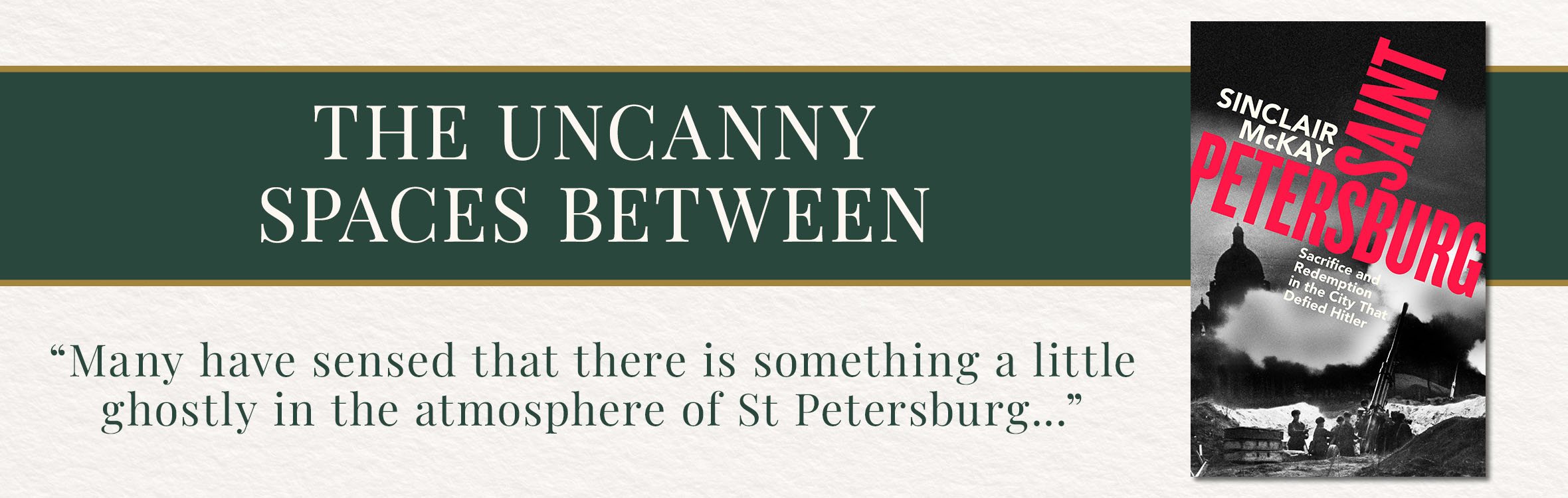
MANY have sensed that there is something a little ghostly in the atmosphere of St Petersburg. The echoing streets, as Bolshevik novelist Viktor Serge observed, could cause time itself to blur, giving the illusion of transportation to a different era. Even now – in a period where Russia is firmly shut off from the gaze of western Europe, and when the frontiers seem utterly impermeable - Petersburg lies on a sort of spiritual borderland.
Famously envisaged as Tsar Peter The Great’s ‘Window on the West’ – an artistic and philosophical crossroads between Europe and wider Russia – the city since its inception in 1703 enfolded and embraced an array of different identities and people: from substantial German and Jewish populations in the 19th and early 20th centuries, to a wide array of faiths, to an extraordinary treasury of architecture and art and engineering marvels.
More elemental borders have always been breached here too: including that between day and night. In the high summer, the faintly uncanny White Nights leave the sun suspended upon the edge of the horizon, leaving the sky sapphire and jade. Come the iron-cold winter, the dark has dominion over the day.
The city’s chroniclers also noted that the borders between land and water were frequently washed away; Petersburg, situated on the Neva at the head of the Baltic Sea, was historically prone to inundation. A cataclysmic flood in 1824 drowned people and horses and the waves rose nine feet high. The city was sometimes likened to the Old Testament ark, floating upon hostile waters.
Here too was a city in which the borders between personal and national identities could blur and find new form. The visionary 19th century novelist Nikolay Gogol was from Ukraine, and Ukrainian was his first language. He came to live and work in Petersburg, adopting Russian as his literary voice; and the two distinct cultural traditions – that of Ukraine, and that of Greater Russia – produced some of the unsettling tension in his most striking works.
Nor did the skyline of Petersburg – from the gleaming spire of the Peter and Paul fortress to the glittering golden dome of St Isaacs cathedral, to the turquoise and cream splendour of the Winter Palace – reflect fierce Russian nationalist certainty. Rather, it was largely the inspiration of Italian and other western European architects. Meanwhile, the no less striking industrial landscape – from the shipyards to the mighty cathedrals of industry in the Putilov and later Stalin works – owed some of their heritage to gifted 19th century Scottish engineers (there was always a notable affinity between the engineering Scots and the Saint Petersburgers).
The beauty of the city’s music and ballet was to cross borders too: Petersburg ballet visionary Sergei Diaghilev took the Ballet Russes to Paris and thereafter astonished (and shocked) the world with The Rite of Spring. Vast concert halls across the continent performed (and still perform) works by Mussorgsky, Rimsky-Korsakov, Tchaikovksy and later by Rachmaninov, Prokofiev and Shostakovich. The latter’s work was to find its own unique place in history during World War 2.
In 1941, when the Nazi invasion of Russia – Operation Barbarossa – brought fire and obscene mass slaughter across eastern Europe, the city of Leningrad (as Petersburg was then called) was completely surrounded by the Wehrmacht. This was a military boundary: the aim of which was to cut off food supplies and starve every single citizen to death. The winter of 1941-42 was apocalyptic: emaciation and lethal cold causing so many hundreds of thousands of fatalities that there was not sufficient ground in the city to accommodate the dead.
Yet in 1942, when the Red Army had succeeded in re-opening some supply routes, and the hunger was, in part, eased, the city demonstrated to the world that art could fly beyond borders. Shostakovich’s Seventh Symphony was especially composed – partly within the city itself, where the composer had a smart apartment - to commemorate war and endurance. Its premiere in the (still) besieged city’s Philharmonic Hall in the summer of 1942 was a transcendent moment of artistic defiance: a work that was broadcast via radio beyond the city, across the world, and into the ears of the nearby Nazi Wehrmacht forces.
The music carried far beyond borders: and spoke of a boundless human spirit soaring above all mortal constraints.
We now live in an age when some borders once more seem impermeable. Russia’s nightmarish war of aggression on Ukraine has defined the philosophical boundary between cynical totalitarianism and liberal democracy. Yet the day must surely come again soon when the borderless soul of Saint Petersburg is restored.