

Posted by Jennifer Clement on 1st February 2024
What is memory? Why do we remember one moment or person and not another? Do our recollections change with time? Is memory fickle and untrustworthy? Do we remember truth? Ever since I wrote my first memoir Widow Basquiat, I’ve been interested in the form my memoirs need to take. Widow Basquiat came to me during a bout of typhoid fever, after writing it in many conventional ways. Closer to poetry and dreams, memory is incomplete, which in a memoir becomes a fragmentary-whole and is very much not a novel.
Boris Pasternak spoke to this in his short memoir Safe Conduct, “I am not writing my biography (…) I believe only the hero merits the actual account of his life, whereas the story of a poet is utterly inconceivable in such form”. Vladimir Nabokov’s memoir Speak Memory is written with an origin in journalism but becomes an episodic work, expressing the fragmentary nature of memory and life. In his opening forward he calls this a ‘systematically correlated assemblage of personal recollections…’
This idea of memory as fragmentary is also sustained in the Mexican poet Octavio Paz’s autobiographical poem Pasado en Claro (Clear Past), which is written in six hundred verses and expresses his life in short descriptions where memory and dreams are in the shadow of each other. In the recollection of his father, he speaks to this, “I never could speak to him. I find him now in dreams, that blurry nation of the dead. We always speak of other things”. T.S. Eliot’s ideas on life as fragmentary are explored in his essay on the metaphysical poets. Eliot wrote, “When a poet's mind is perfectly equipped for its work, it is constantly amalgamating disparate experience; the ordinary man's experience is chaotic, irregular, fragmentary. The latter falls in love, or reads Spinoza, and these two experiences have nothing to do with each other, or with the noise of the typewriter or the smell of cooking; in the mind of the poet these experiences are always forming new wholes.”
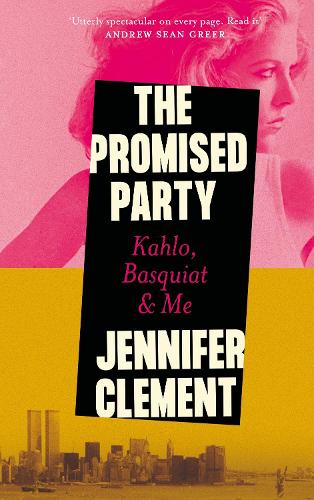
The Promised Party, in this tradition, is a fragmentary memoir about childhood and youth and an intellectual exploration of the influences and events that contributed to my becoming a poet and a writer. When I write about bathing in Frida Kahlo’s bathtub, I imagined, ‘The water held a large seashell full of holes, which were bullet holes. The water carried an island with a volcano, a dead woodpecker and an empty Mexican dress. In the grey soapy water, there was a small skeleton resting on a hill. The bathtub, which held (my small body) still contained Frida.’ And I remember the gardener who’d been a bullfighter: ‘Sometimes, Apolinar would roll up his trousers and show us the round, oyster-shell-coloured wounds in his legs from the days he’d been gored in the bullring. Apolinar told us he liked to rebel against anything that wanted to take his life. He said nobody fights a bull to die but the beauty of the bullfight fiesta depends on how willing you are to die’. When I moved to New York during the time of AIDS, my fragments of memories were of clubs and parties and blood tests. ‘The word ‘negative’ was a beautiful word filled with sunlight and a desire to run and run. Suddenly we were all writing, painting and singing about the body and mortality. We wanted our work to overflow with courage and rage. Jean-Michel Basquiat’s paintbrushes, paint sticks or little-kid crayons were swords, daggers and knives’.
Vladimir Nabokov wrote on memory, “I think it is all a matter of love: the more you love a memory, the stronger and stranger it is”. The Promised Party opens with, ‘I was strange to myself. Slept uneasy. I walked between raindrops.’ And, inside these pages, there are memories I love.
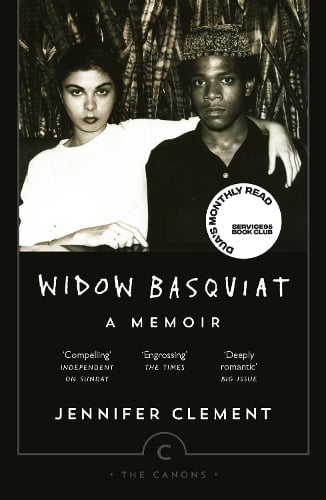 Widow BasquiatJennifer ClementPrice: £10.99A tender and moving account of Jean-Michel Basquiat's life as seen through the eyes of his muse, by award-winning author... See moreA tender and moving account of Jean-Michel Basquiat's life as seen through the eyes of his muse, by award-winning author and PEN International President Jennifer Clement See more