Posted by Robert Edric on February 27th, 2022
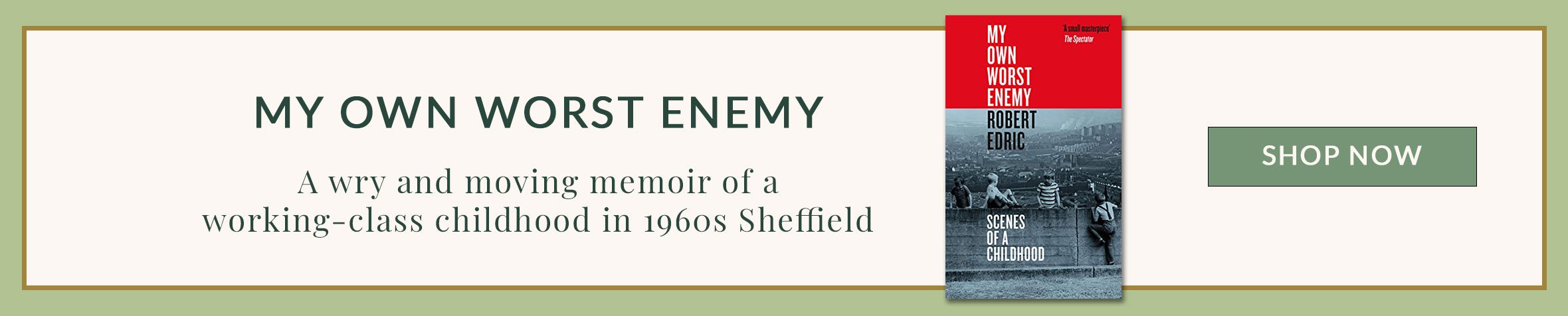
Robert Edric is a widely celebrated novelist, winner of the James Tait Black Prize and WH Smith Literary Award, and with nominations from the Booker Prize and Guardian Prize. He now applies his trademark candour to his first wry, honest and moving memoir of a now-vanished era of working-class 1960s Sheffield. My Own Worst Enemy explores the relationship between a touchy, overbearing and tragicomic bully of a father and a son whose acceptance to grammar school puts him on another track entirely. In clear-eyed but compassionate prose, Robert Edric vividly depicts this lost era of working-men’s clubs; of tight-knit communities in factory towns; and of a time when a woman’s place was only in the home. He brings to colourful life his family, both immediate and extended – over which hovers the barely-repressed frustration and anger of his own father. My Own Worst Enemy is a brilliantly specific portrait of both a particular time and place and a universal story of childhood and family, and the ways they can go right or wrong.
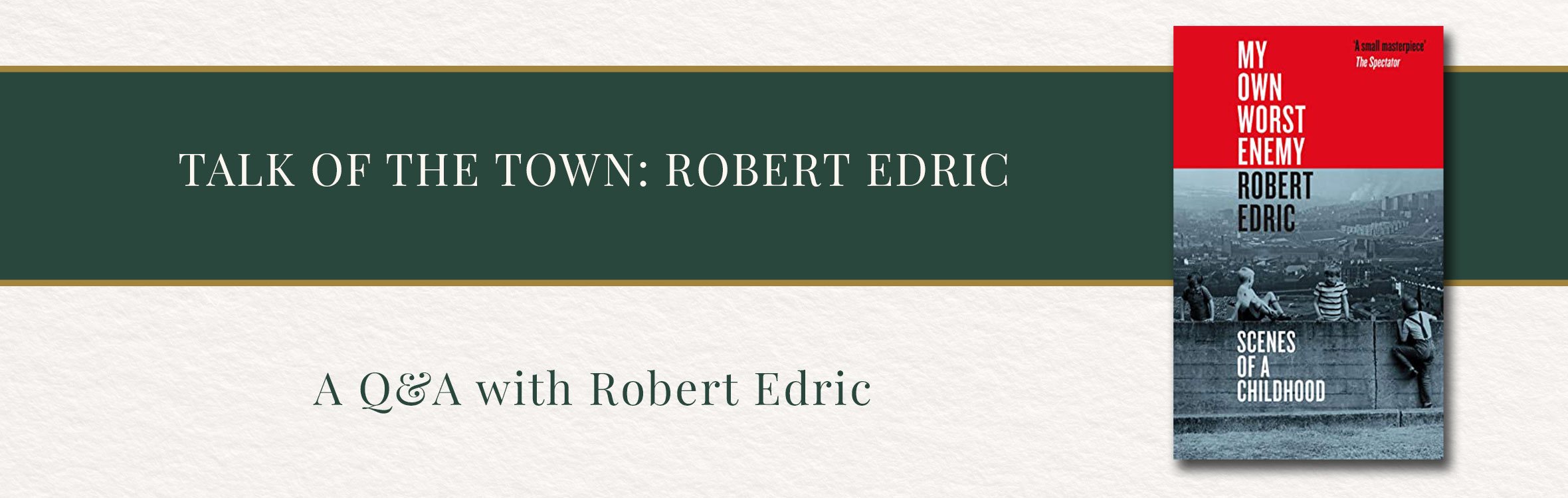
A Q&A with Robert Edric
Describe in your own words ‘My Own Worst Enemy’.
My Own Worst Enemy is a memoir of my childhood and teenage years in Sheffield of the 1960's and '70's. More specifically, it is a series of vignettes – the Scenes Of A Childhood of the subtitle – of people, places and events which have remained with me over the past fifty or sixty years. Nothing in the memoir is researched, confirmed by other sources, or (as far as possible when writing so many years later) viewed overtly retrospectively. These are the events and people of my childhood as I remember them and as I have occasionally told them to others.
You’ve previously published 30 books, all novels, what made you want to write a memoir this time? What was your main inspiration?
My writer's imagination has, of course, shaped, edited and condensed these events and vignettes, but all are true to my actual memories of them. There is certainly no patina of nostalgia, melodrama or embellishment for dramatic effect. Anyone familiar with any of my previous fiction will know that, wherever possible, I eschew all embellishment, showing rather than telling, always trusting the tale above the teller.
What was the writing experience like writing about your own family? Did it feel markedly different to writing a novel?
This is my first memoir, and is the result, largely, of a lockdown in which, the future uncertain, I decided to gather together all the small pieces I had written during the past two or three years to examine the 'whole' they might make. My Own Worst Enemy is the result: a compendious, kaleidoscopic scatter of pieces which gradually coalesce to create as full and as honest an account of the pieces of my childhood as I remember them. Some of those events now seem momentous to me, some trivial, but they all played their vital part in creating the child I was and the writer I became.
'My Own Worst Enemy' is a brilliantly specific portrait of a time and place - Sheffield in the 1960s - how much of that time do you remember or did you have to go back and do some research?
As with all memoirs, it was my aim to show not only the specific details of a single existence and a child's forming mind and character, but also to reflect more broadly on the environment in which that took place. The Sheffield of 1956 to 1974 was a considerably different place to the city of today, and even then, I saw that I was living in place both detaching itself from the war which had devastated its heavy industries and housing stock, and at the same time moving into a planned and much anticipated future. However much or little of this I truly understood at the time, it was the world I inhabited, and Enemy, hopefully, reflects that.
What motivates you generally as an author? Where do you find your inspiration?
Hitherto, I have been motivated to write my fiction by an interest in the book's subject – Arctic exploration, P.T. Barnum's museum, Ivor Gurney's incarceration in the Dartford Asylum, Branwell Brontë's final days, the construction of a War Cemetery in 1920 – and have researched the foundations of the novel before building my own characters and events on top of this. It is something I've done for over 30 years and has proved a reassuring way of working. With Enemy I was reliant on a completely different structure and process. The fifty individual pieces were written and honed, kept or rejected as distinct and separate pieces, and with the exception of the final chapter, were then 'juggled' into place to create the most satisfying whole.
Describe your writing day/routine.
Regardless of my internal methods, my writing routine has been near-identical for those past 30 years. I live on the North Sea coast, and so following an hour-long walk along the beach with the dog I work on first drafts in longhand – pencil and paper on A4 faintly-lined paper – after which I revise two or three times, still in pencil, before typing up and creating a file. During this process the novels are at least halved in length, and occasionally changed completely from the books they were intended to be. My bulky archive is in the University of East Anglia at Norwich and so all of this can be checked and confirmed by anyone with the inclination to get their hands dirty.
Which novel are you most proud of and why?
Hard to say what I consider my 'best' work to be. The only books that ever turned out as I fully intended them were my black comedy A New Ice Age and my last novel, Mercury Falling. This is neither a fault nor a bonus; the so-called 'journey' was the same.
What’s the best writing advice you’ve ever had? What would you say to a writer starting out?
The only advice I would want to give to anyone starting out writing today, is simply to trust your own instincts and stop worrying about either the end result or what it is you are 'supposed' to be writing.
What are you reading now?
I am currently (and through many insomniac nights) reading my usual ten or twenty titles (did I mention my insomnia?) including Paul Auster's biography of Stephen Crane, Jennifer Otter Bickerdike's biography of Nico, Stuart Maconie's memoir of the Nanny State, Dylan Jones' oral history of The New Romantics, and Amy Hale's study of Ithell Colquhoun (yes – that Ithell Colquhoun.) I am usually back to sleep about an hour before it's time to get up and walk the dog.
What are you looking forward to in 2022?
And what am I most looking forward to in 2022? Probably the fact that it won't be 2021. Or 2020, for that matter.